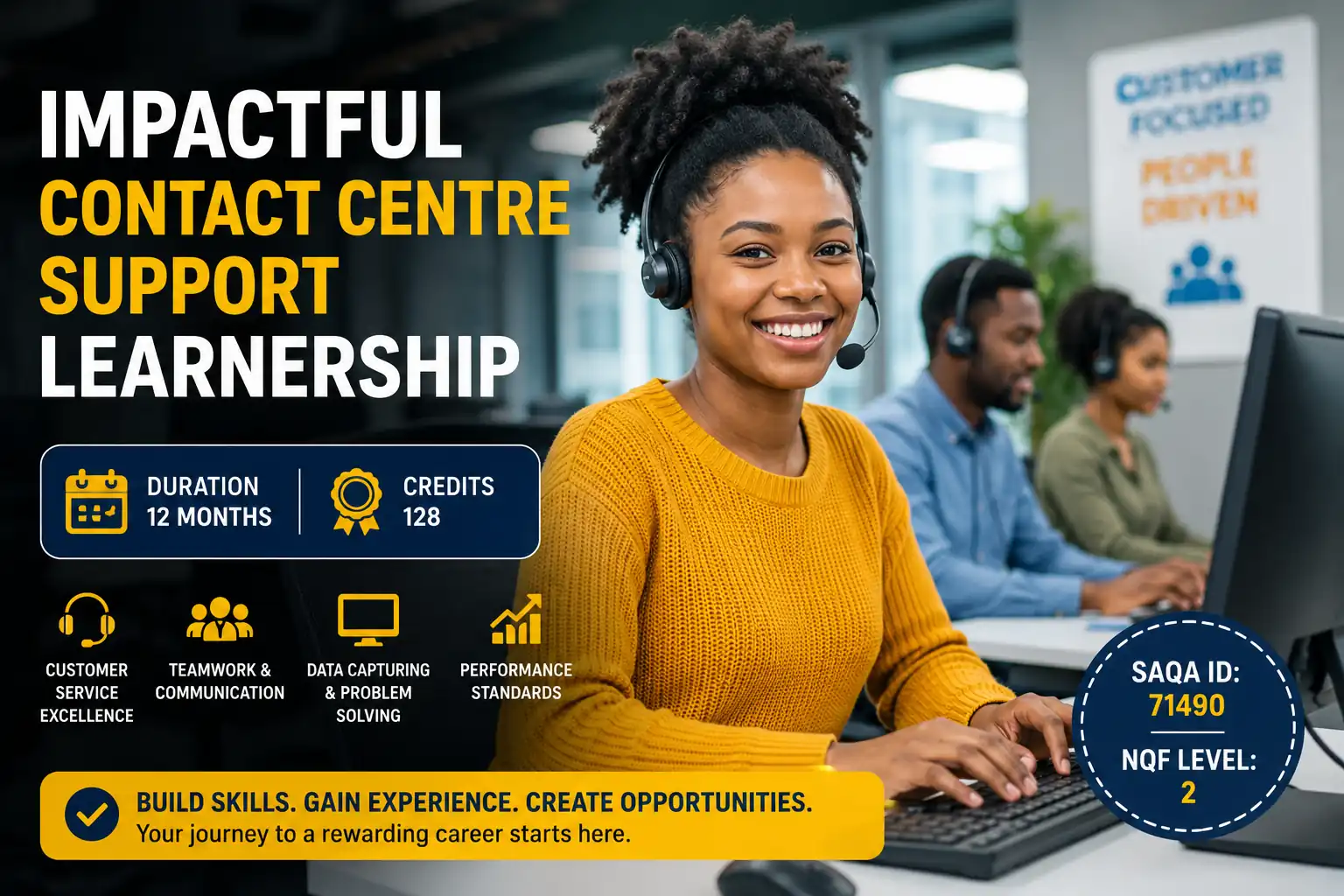
Explore the National Certificate: Impactful Contact Centre Support Learnership (SAQA ID 71490), a 12-month Services SETA-accredited qualification designed to prepare learners for careers in customer service and contact centres.
Contact Centre Skills Could Open More Career Doors for South African Youth in 2026
- Author: Tenae Nkosi
- Category: Learnerships
- Published Date: 15 June 2026
- Target Audience: Unemployed Youth, Matriculants, Entry-Level Job Seekers, Customer Service Professionals, Contact Centre Aspirants
Contact Centre Support Learnership Overview
- Qualification Name: National Certificate: Impactful Contact Centre Support
- SAQA ID: 71490
- NQF Level: 2
- Duration: 12 Months
- Total Credits: 128
- Minimum Contact Sessions: 80 Days
- Assessment Requirement: Final Integrated Summative Assessment (FISA)
- Recognition of Prior Learning (RPL): Available
- Credit Accumulation Transfer (CAT): Available for approved learners
Minimum Entry Requirements
- Grade 12
- Numeracy at NQF Level 1 or equivalent
- English at NQF Level 1 or equivalent
- Second Language at NQF Level 1 or equivalent
- Computer Operating Skills at NQF Level 2 or equivalent
South Africa’s Customer Service Industry Continues to Create Opportunities
While many young people focus on careers in engineering, healthcare, or information technology, another sector quietly continues to employ thousands of South Africans every year.
The contact centre and business process outsourcing (BPO) industry has become one of the country’s fastest-growing employment sectors. Companies across banking, retail, telecommunications, insurance, healthcare, and e-commerce depend on skilled professionals who can assist customers, solve problems, manage information, and deliver exceptional service.
As businesses place greater emphasis on customer experience, the demand for trained contact centre professionals continues to grow.
This is one reason why the National Certificate: Impactful Contact Centre Support remains a relevant qualification for individuals seeking practical workplace skills and entry-level career opportunities.
Why This Learnership Matters in 2026
The modern workplace is changing rapidly.
Customers expect faster responses, better service, and accurate information regardless of whether they interact with a business through phone calls, email, social media, live chat, or digital platforms.
As organisations invest more heavily in customer support operations, employers are increasingly searching for candidates who understand both communication and technology.
This learnership helps participants develop those skills.
Rather than focusing solely on theory, the programme introduces learners to the realities of working in a customer-focused environment where communication, professionalism, teamwork, and performance standards matter every day.
For many young people entering the labour market, these are transferable skills that remain valuable across multiple industries.
What Learners Can Expect to Gain
Participants are introduced to the fundamentals of the contact centre environment while building practical workplace competencies.
Areas covered include:
- Customer communication
- Problem-solving techniques
- Data capturing and information management
- Telephone etiquette
- Customer complaint resolution
- Workplace professionalism
- Team collaboration
- Contact centre performance standards
- Computer-based operations
- Business communication skills
These capabilities are often sought after not only in contact centres but also in customer service, administration, retail, sales support, and office-based roles.
Career Opportunities After Completion
Learners who complete the qualification may pursue opportunities such as:
- Contact Centre Agent
- Customer Care Consultant
- Data Capturing Clerk
- Telemarketing Agent
- Sales Consultant
- Customer Service Representative
- Contact Centre Coach
- Contact Centre Supervisor
- Business Process Outsourcing (BPO) Agent
While employment outcomes depend on individual circumstances and labour market conditions, the qualification provides a recognised foundation for entry into customer service-related careers.
Learning Programme Structure
The qualification consists of Fundamental, Core, and Elective unit standards totalling 128 credits.
Learning Programme 1: Contact Centre Culture
Learners are introduced to the culture and expectations of a professional contact centre environment.
Unit Standard Included:
- Instil in myself a personal Contact Centre culture (SAQA ID 13872)
Learning Programme 2: Numeracy Fundamentals
Learners develop practical mathematical skills used in workplace environments.
Topics include:
- Statistics and probability
- Number systems
- Patterns and functions
- Shapes and measurements
- Personal and community financial calculations
Learning Programme 3: Business Communication
Strong communication remains one of the most important workplace skills.
Learners cover:
- Accessing and using information from texts
- Workplace communication
- Oral communication techniques
- Business writing and presentation skills
Learning Programme 4: Dealing with Customers
Customer service forms the heart of the qualification.
Learners are trained to:
- Identify customer needs
- Provide accurate information
- Resolve customer complaints
- Deliver quality customer experiences
Learning Programme 5: Collecting, Recording and Problem Solving
This section focuses on:
- Capturing customer information accurately
- Recording customer requests
- Gathering information for problem-solving
- Supporting workplace decision-making
Learning Programme 6: Performance Standards in the Contact Centre
Learners gain exposure to operational requirements such as:
- Data input and computer systems
- Performance management standards
- In-bound contact centre operations
- Out-bound contact centre operations
Learning Programme 7: Working in Teams
Modern workplaces rely on collaboration.
Learners develop skills in:
- Teamwork
- Workplace diversity
- Professional relationships
- Effective workplace participation
Technology Requirements
To successfully participate in the programme, learners may require access to:
- Computer or laptop
- Display monitor
- Keyboard and mouse
- Printer (where applicable)
- Windows operating system
- Microsoft Office software
Digital literacy is becoming increasingly important across virtually every sector of the economy, making these requirements relevant to workplace readiness.
Workplace Exposure Remains Essential
A major strength of the qualification is its focus on workplace exposure.
Learners must be exposed to outcomes associated with the qualification in a workplace environment. This practical component allows participants to apply knowledge in real-world situations while building confidence and professional experience.
Mentors supporting learners should have at least five years of experience in a contact centre, BPO, or similar customer-focused environment.
Other open opportunities you can apply for:
- AfriSam In-Service Training Programme
- Masingita Group Asset Management Learnership
- Truworths Store Work Integrated Learning Learnership
Frequently Asked Questions
Who can apply for this learnership?
Individuals who meet the minimum academic and computer literacy requirements may be considered for participation.
Is workplace experience required?
No previous workplace experience is typically required, although learners must complete workplace-based exposure during the programme.
How long is the qualification?
The learnership runs for 12 months.
Does the programme include assessments?
Yes. Learners must complete assessments, Portfolio of Evidence (PoE) activities, and the Final Integrated Summative Assessment (FISA).
Is Recognition of Prior Learning available?
Yes. The qualification allows for Recognition of Prior Learning (RPL) where applicable.
Final Thoughts
Many young South Africans are searching for opportunities that provide both practical experience and recognised qualifications.
The National Certificate: Impactful Contact Centre Support offers a pathway into a sector that continues to create employment opportunities while helping learners develop communication, customer service, technology, and workplace skills.
As businesses increasingly compete on customer experience, individuals who understand how to communicate effectively, solve problems, and support customers professionally may find themselves well positioned for future career opportunities.
For learners looking to build a foundation in customer service and workplace professionalism, this qualification remains a valuable option in 2026.

Hello, I am Tenae Nkosi, founder, author, and administrator of LearnersTag. I graduated with a Diploma in Information Administrative Management from Tshwane University Of Technology in 2022.
For enquiries, collaborations, or advertising opportunities, contact us at info@learnerstag.org or visit LearnersTag Official Website.